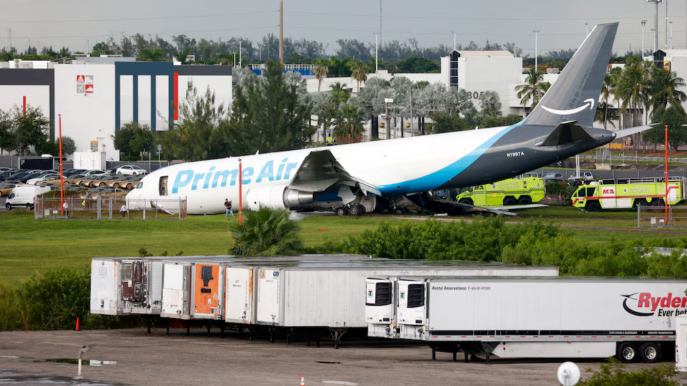
Cargo Jet Overruns Miami Runway, Kills at Least Five in Ground-Level Collision
Bdbusinessdaily.com – An Amazon Prime Air freighter slid past the end of a runway at Miami International Airport on Sunday afternoon, plowing into parked vehicles and killing at least five people before emergency crews scrambled to the scene. The crash, which sent shockwaves through one of Florida’s busiest aviation hubs, marked the second fatal accident involving an aircraft flying under the Amazon Prime Air cargo banner in roughly six years.
Flight 7598, operating out of San Juan, Puerto Rico, attempted to land on the airport’s diagonal runway just before 2:00 p.m. Eastern Daylight Time (1800 GMT). The aircraft failed to stop within the available pavement and continued forward at speed, striking several vehicles positioned on the ground beyond the runway threshold. Miami-Dade Fire Chief Ray Jadallah confirmed the toll at a Sunday afternoon press briefing: five fatalities and five additional injuries, three of them in critical condition.
Rescue Effort and Immediate Aftermath
The collision trapped at least two individuals inside the vehicles that were struck, while the pilot and co-pilot were pinned within the fuselage of the downed aircraft. Jadallah told reporters that more than 60 rescue units and roughly 200 personnel converged on the crash site. As late as the afternoon hours, crews were still managing an active fuel leak from the wreckage, a hazard that complicated extraction operations and required sustained containment efforts.
Miami International Airport suspended all departures and arrivals the moment the crash was confirmed. By Sunday evening, however, two of the facility’s four runways had been cleared and reopened, allowing a partial resumption of commercial traffic. The airport’s closure, even if temporary, rippled through regional flight schedules and added congestion to an already saturated Southeast corridor.
The Aircraft and Its Operator
Flight-tracking data from Flightradar24 indicated the jet was traveling at approximately 112 knots (129 mph) at the moment it departed the usable runway surface. The aircraft itself was a Boeing 767-300 freighter, 32 years old at the time of the crash. Before its conversion to cargo service, the airframe had spent more than two decades flying passengers for various airlines between 1994 and 2015.
The plane was being flown by 21 Air, a cargo carrier that operates aircraft under contract for Amazon’s Prime Air logistics network. An Amazon spokesperson confirmed the arrangement in a written statement. Visual documentation taken after the crash showed the jet resting with its nose section on the ground and tail section angled upward, while the right flank of the fuselage bore what appeared to be extensive scorch marks consistent with a ground-contact slide.
Statements from Amazon and 21 Air
Amazon’s corporate response came through spokesperson Kelly Nantel, who said the company was still assembling details of the sequence of events.
“We’re working closely with local authorities and officials to understand exactly what happened,” Nantel said. “Right now, our absolute priority is the safety, well-being, and care of everyone involved.”
21 Air issued its own statement on its website, expressing grief over the loss of life.
“We are devastated by the accident involving one of our aircraft in Miami today,” the carrier said. “Our deepest condolences are with the families and loved ones of those who lost their lives.”
Both Boeing and 21 Air indicated they would cooperate fully with the government investigation into the crash.
NTSB Investigation Underway
The National Transportation Safety Board, the federal agency charged with investigating civil aviation accidents in the United States, dispatched a team to Miami led by Chairwoman Jennifer Homendy. The board announced it would hold its first public media briefing in Miami on Monday, setting the stage for what is expected to be a lengthy inquiry into runway-excursion dynamics, weather conditions at the time of landing, and the state of the aircraft’s braking and steering systems.
Officials at the scene declined to publicly identify the five individuals who died, pending notification of next of kin. The identities of the injured were likewise withheld.
A Pattern Amazon Has Not Fully Escaped
Sunday’s tragedy is not an isolated incident in the history of Amazon’s cargo aviation operations. In February 2019, Atlas Air Flight 3591 — also a Boeing 767-300 freighter flying under the Amazon Prime Air banner — departed Miami bound for Houston. En route, the aircraft entered a rapid descent and struck the waters of Trinity Bay, Texas. All three crew members aboard were killed. That accident prompted a review of cargo-flight procedures and crew-rest standards across the industry.
Amazon’s Prime Air program has grown into one of the largest private cargo networks in the country, moving packages and goods across the continent on a fleet of converted wide-body jets. The scale of that operation means the company’s aircraft regularly share runways with commercial passenger traffic at major hubs like Miami, where a single over-run event can cascade into collisions with ground vehicles, airport infrastructure, and, as Sunday demonstrated, human lives on the tarmac.
The crash underscores a persistent tension in modern aviation: the conversion of aging passenger airframes into freighters extends their useful life and supports e-commerce logistics, yet it also places decades-old structures into high-frequency operational cycles at airports designed around passenger-traffic assumptions. Investigators will now have to determine whether maintenance history, weight-and-balance limits, runway-condition reporting, or pilot inputs played a role in Flight 7598’s failure to stop.
For the families of the five killed and the five injured, the question of cause will come later. What remains immediate is the human cost of a cargo jet that could not find its end of the runway.
Related Reading
Frequently Asked Questions
What is At least 5 killed in Amazon?
At least 5 killed in Amazon is the main topic of this guide. The article explains the context, practical details, and next steps readers should understand.
Why does At least 5 killed in Amazon matter?
At least 5 killed in Amazon matters because readers are looking for a useful answer, not just a short summary. Good content should match search intent and help them decide what to do next.