A Second-Year Student Spent Two Months Alone in a Contaminated River — and No One Funded Him
Bdbusinessdaily.com – India’s rivers carry a staggering pollution burden. Decades of untreated industrial discharge, open defecation, agricultural runoff, and casual littering have turned waterways across the country into open sewages. Government clean-up programmes, when they exist at all, tend to arrive late, under-resourced, and politically conditional. Into that gap of institutional inaction stepped a young man with no budget, no training, and no guarantee of survival beyond the next few weeks of immersion in toxic water.
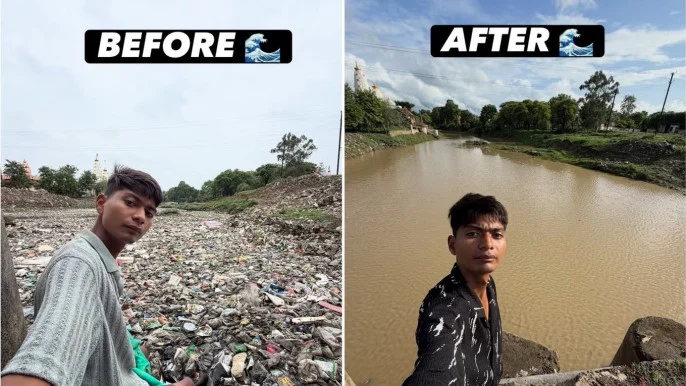
Surendra Singh Chaudhary, a 20-year-old BSc student enrolled at a college in Biaora, Rajgarh district, Madhya Pradesh, spent more than two months wading through a heavily polluted stretch of the Ajnar River, pulling out waste by hand. He went online under the handle “Bittu Tabahi,” and his story exploded across Indian social media in early 2025 after a single tweet from industrialist Anand Mahindra put the cleanup in front of millions of viewers.
How the Idea Took Root
Chaudhary did not announce a grand environmental manifesto. The impulse was quieter, more personal. He described the thought process that preceded the physical labour:
“I used to think about it beforehand. Whenever I used to go to the temple or went past the river, I used to think about cleaning the river.”
The Ajnar flows through the rural heartland of Rajgarh district, a region where small rivers double as communal bathing spots, agricultural irrigation channels, and, increasingly, dumping grounds. For a young man growing up beside that water, the sight of floating refuse was not an abstract policy problem; it was a daily visual assault.
He began the physical work on 26 January. Friends joined him in the early days, but their participation faded within weeks.
“Yes, I had friends. But gradually, things started to change. Some people liked it and some didn’t,” Chaudhary recalled.
No Funding, No Gear, No Swimming Ability
The operational realities were stark. Chaudhary could not swim when he started. He had no wetsuit, no rubber boots, no gloves rated for chemical-laden water. He simply stepped in.
The body kept score. Prolonged contact with the contaminated water caused the skin on his hands and feet to peel. Persistent fungal and bacterial infections set in around his feet. There was no occupational-health department to file a claim with, no insurance policy to invoke. The cost was paid in tissue and nerve endings.
On the financial side, the project received zero government funding. Chaudhary and a handful of friends pooled roughly 30,000 rupees (about $350) to buy basic tools and install a small number of dustbins along the riverbank, hoping to discourage further littering.
“I had installed a few dustbins as well around the river. Dustbins were installed by myself only, no funding from anyone,” he stated.
He also gathered discarded religious offerings — marigold garlands, flower petals, and other ritual items left in the water — and composted them into organic soil amendment, closing a small nutrient loop that the river itself could no longer process.
From Obscurity to National Attention
Chaudhary kept the effort largely secret from his own household. His family in Biaora did not know the scale of what he was doing until the story escaped into the public sphere.
“My family didn’t know about it. They found out when Anand Mahindra posted it on Twitter.”
Mahindra’s post, shared to his large following, reframed a local act of stubbornness into a national narrative about youth agency and environmental neglect. Within days, former England cricketer Kevin Pietersen weighed in on social media:
“I read this story this am and wanted to share it with you! WELL DONE, Bhai! Heroic, I say! Deserves international recognition!”
The family’s reaction, once the full picture reached them, was protective alarm. They urged him to stop working alone, warning that his health would deteriorate further.
“They told me not to do it alone. Your health will be affected and things like that,” Chaudhary relayed their concern.
Local Ridicule and Online Skepticism
Not every reaction was admiring. In his own community, neighbours mocked the effort.
“They make fun of me, call me crazy.”
Online, a different scepticism emerged. Some social-media users questioned whether the dramatic before-and-after footage of the river’s transformation was generated by artificial intelligence rather than captured on camera. Chaudhary addressed the accusation directly in an Instagram video, showing himself physically breaking up sediment and operating a small JCB excavator to remove accumulated silt.
“After cleaning the river so much, people will call it AI. I used to clean the river by breaking it. Then I used JCB’s help to clean the dirt in the river. You can see that I have not done this work with AI. I have done this work with my hard work.”
The River Is Clean — The Problem Is Not
By the time the story reached national attention, the stretch of the Ajnar Chaudhary had worked on was, in his words, “very clean.” Yet he was candid about the fragility of that result. Public littering continued around the cleaned section, and he had no enforcement authority to stop it.
“I don’t know why people throw garbage in the river. I don’t know why they do that. You can’t stop them.”
The Ajnar, like hundreds of smaller rivers across central India, feeds local agriculture, supports livestock watering, and carries cultural significance tied to temple rituals. Its degradation is not merely aesthetic; it propagates waterborne disease, depletes soil fertility downstream, and erodes the livelihoods of farming families within a few kilometres of its banks. A single student’s two-month intervention, however heroic, cannot substitute for sustained municipal waste management, industrial effluent regulation, and community sanitation infrastructure.
Chaudhary, nonetheless, has no intention of treating the cleaned stretch as a finished project. His stated next step is scale.
“Currently, I want to do it on a bigger level.”
Whether that ambition materialises will depend on whether the attention his story generated translates into institutional support — funding, protective equipment, medical follow-up, and municipal cooperation — or whether it fades into the next viral cycle, leaving the young man once again alone in the water, peeling skin and all.
Related Reading
Frequently Asked Questions
What is How a 20 yr old single?
How a 20 yr old single is the main topic of this guide. The article explains the context, practical details, and next steps readers should understand.
Why does How a 20 yr old single matter?
How a 20 yr old single matters because readers are looking for a useful answer, not just a short summary. Good content should match search intent and help them decide what to do next.