Eastern Bank expands access to low-cost financing for green and ICT investments
Bdbusinessdaily.com – Eastern Bank PLC has entered into two new agreements with Bangladesh Bank that will allow it to extend preferential financing to qualifying customers investing in environmentally responsible industrial projects and information and communication technology initiatives.
The arrangements bring EBL into Bangladesh Bank refinance programmes designed to support green factory buildings, green industries and the country’s growing ICT sector. Eligible borrowers may receive financing of up to Tk100 crore for approved green projects at an interest rate capped at 5% a year. Eligible ICT ventures can access up to Tk50 crore, with the maximum annual interest rate set at 4%.
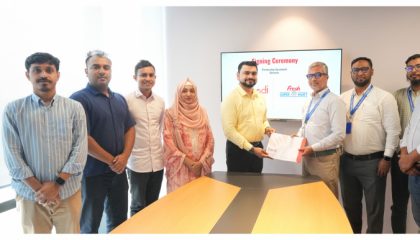
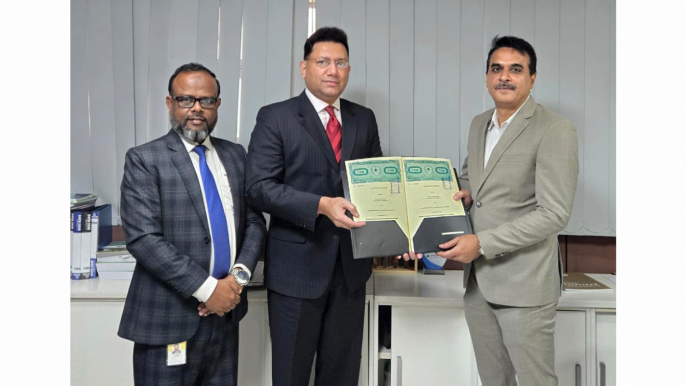
Bangladesh Bank Sustainable Finance Department Director AKM Nurunnabi signed the participation agreements for the central bank, while EBL Chief Executive Officer Hassan O Rashid signed on behalf of Eastern Bank. EBL Head of SME Business Md Sabu Munsi attended the signing ceremony.
Support for greener industrial development
One of the agreements relates to the Tk1,000 crore Refinance Scheme for Green Factory Building and Green Industry. The programme is intended for projects that establish environmentally responsible industrial facilities and green factory buildings.
Under the scheme, a qualifying borrower may obtain as much as Tk100 crore in financing, subject to the applicable Bangladesh Bank conditions. The interest rate cannot exceed 5% per annum.
The scheme creates a financing route for industrial investors seeking to build or develop facilities with environmental considerations at the centre of their plans. Green factory buildings and sustainable industrial infrastructure often require investment decisions that extend beyond ordinary construction or production needs. Access to refinance-backed lending can help eligible businesses consider such projects with more predictable borrowing costs.
For companies planning new factories or upgrades, the programme is relevant because it links financing eligibility to environmentally responsible development. The emphasis is not only on industrial expansion, but also on the type of infrastructure being developed and the broader direction of investment.
By participating in the scheme, EBL can serve as a channel between eligible borrowers and the Bangladesh Bank refinance facility. This gives businesses that meet the programme requirements an additional avenue for seeking funding through a commercial bank.
Financing channel for ICT-sector growth
The second agreement concerns the Tk1,000 crore Refinance Scheme for the Development of ICT Sector. It provides qualifying customers with access to loans of up to Tk50 crore at a yearly interest rate of no more than 4%.
The ICT facility gives priority to products and services developed at Bangladesh Hi-Tech Parks and software technology parks. Women entrepreneurs working in the ICT sector are also among the groups identified for priority under the scheme.
A broad range of technology-focused activities can fall within the programme’s scope. These include software development, artificial intelligence, financial technology, cybersecurity, cloud computing, e-commerce, robotics and data analytics. Other technology-related areas identified in Bangladesh Bank guidelines may also be eligible.
The coverage reflects the wide variety of businesses that now make up the ICT economy. A software developer, a cloud-based service provider, a cybersecurity-focused enterprise or a business working with data-driven products may have different operational models, but each depends on investment in skills, systems, platforms and technology infrastructure. The refinance scheme is designed to support eligible activity across these areas.
The lower interest-rate ceiling under the ICT facility may be particularly significant for ventures whose growth depends on sustained investment before commercial scale is reached. For technology businesses, financing needs may involve product development, digital systems, specialised services or expansion into new customer segments. Eligibility, loan size and final financing terms remain subject to the central bank’s conditions.
What the agreements mean for borrowers
The agreements do not make every green or technology-related proposal automatically eligible. Businesses seeking financing will need to meet the requirements set out for the respective Bangladesh Bank schemes. The projects, borrowers and uses of funds must fit within the applicable conditions.
For eligible applicants, however, the programmes establish clear maximum financing levels and interest-rate ceilings. Green factory building and green industry projects can seek financing up to Tk100 crore at a maximum 5% annual rate, while eligible ICT-sector initiatives can seek up to Tk50 crore at a maximum 4% annual rate.
The difference in financing limits reflects the separate focus of the two programmes. Industrial and infrastructure projects can involve large physical investments, including factory construction and facility development. ICT projects may involve different forms of investment, but the dedicated scheme recognises their role in technology development and competitiveness.
Customers interested in either facility will need to consider whether their planned project fits the stated objectives. Green-industry applicants should be able to demonstrate an environmentally responsible factory or industrial development focus. ICT applicants should assess whether their activities align with the sectors and technologies included in Bangladesh Bank’s guidelines.
A combined push for sustainable and digital investment
The two refinance programmes pursue related economic objectives through different sectors. The green financing scheme is intended to encourage investment in sustainable industry and infrastructure. The ICT programme seeks to strengthen development and competitiveness within Bangladesh’s technology sector.
Together, they highlight the importance of both physical and digital capacity in business growth. Modern industrial development increasingly places value on environmental responsibility, while technology-based services and products have become central to innovation across many parts of the economy.
EBL’s participation gives qualifying customers a bank-based route to pursue these refinance facilities. The agreements also connect two policy priorities: building industrial capacity with environmental considerations and supporting technology businesses working in areas ranging from software and artificial intelligence to fintech, robotics and cloud computing.
For prospective borrowers, the practical next step is to examine the Bangladesh Bank conditions governing each programme and discuss project eligibility with EBL. The available facilities offer defined financing ceilings and capped rates, but approval will depend on whether the proposed investment meets the relevant requirements.
Related Reading
Frequently Asked Questions
What is EBL joins BB refinance schemes for green?
EBL joins BB refinance schemes for green is the main topic of this guide. The article explains the context, practical details, and next steps readers should understand.
Why does EBL joins BB refinance schemes for green matter?
EBL joins BB refinance schemes for green matters because readers are looking for a useful answer, not just a short summary. Good content should match search intent and help them decide what to do next.