AAUB strengthens faculty capacity for outcome-based education
Bdbusinessdaily.com – Aviation and Aerospace University, Bangladesh (AAUB) has brought faculty members and academic officials together for a full-day programme focused on improving teaching methods, curriculum planning, student assessment and academic quality assurance.
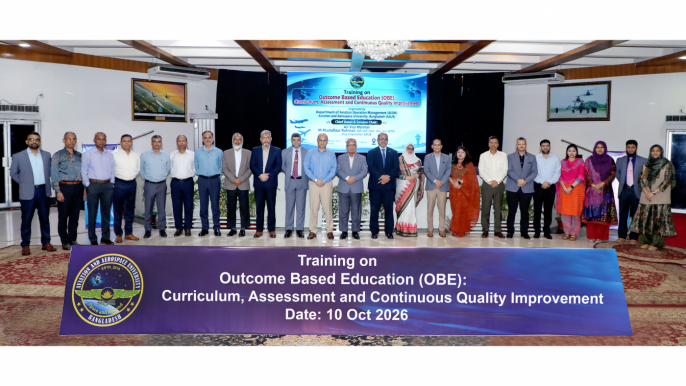
Held on 10 October at Falcon Hall in Tejgaon, Dhaka, the training was arranged by the university’s Department of Aviation Operation Management. Participants joined from AAUB’s campuses in Dhaka and Lalmonirhat, reflecting an effort to develop a shared approach to academic standards across the institution.
The programme, titled Training on Outcome-Based Education: Curriculum, Assessment and Continuous Quality Improvement, examined how universities can make teaching more clearly connected to the knowledge, practical skills and professional abilities students are expected to gain by the end of their studies.
Focus on learning outcomes and assessment
Outcome-based education places emphasis on what learners should be able to demonstrate after completing a course or programme. Rather than concentrating only on the delivery of course material, the approach requires instructors to define learning outcomes, organise teaching activities around those outcomes and assess whether they have been achieved.
For an institution working in aviation and aerospace-related fields, this approach can help faculty make course expectations more measurable and better aligned with the needs of technically demanding professional sectors. It also supports a student-centred academic environment, where progress can be evaluated through evidence of learning rather than attendance or examination marks alone.
The training included four specialised sessions covering the Bangladesh National Qualifications Framework, the core principles of outcome-based education, curriculum development and alignment, learning-outcome mapping, attainment measurement, rubric-based assessment and continuous quality improvement.
Participants took part in discussions, practical tasks and group exercises designed to help them connect course-level learning outcomes with broader programme objectives. The sessions also explored ways to create assessment methods that can more effectively measure student performance and identify areas requiring improvement.
University leadership joins the programme
Air Vice Marshal M Mustafizur Rahman, vice-chancellor of AAUB, attended the event as chief guest and chaired the sessions. Air Commodore Md Rabiul Hasan, dean of the Faculty of Aerospace Management and Entrepreneurship, delivered the opening address.
Assistant Professor Dr Hosnay Nasrin, chairman of the Department of Aviation Operation Management, welcomed the participating faculty members and officials at the beginning of the programme.
Professor Dr Syed Shahrier Rahman of the Department of Linguistics at Dhaka University conducted the main sessions. He previously served as additional director of Dhaka University’s Institutional Quality Assurance Cell, bringing experience in university quality-assurance processes to the training.
Other resource persons included Professor Dr Mohammad Sarwar Morshed from the Department of Mechanical and Production Engineering at Ahsanullah University of Science and Technology, along with Associate Professor Dr Naznin Sultana Chaity of the university’s School of Business. Dr Chaity also serves as additional director of the institution’s Institutional Quality Assurance Cell.
Building a culture of continuous improvement
Academic quality assurance is not limited to reviewing a syllabus or setting an examination. It involves regular examination of whether teaching plans, assessments and student outcomes remain connected, and whether evidence from those processes is used to improve future courses.
During the programme, faculty members considered how systematic evaluation can support better curriculum decisions and more consistent assessment practices. Rubrics, outcome mapping and attainment reviews were presented as tools that can help instructors make evaluation criteria more transparent and identify where students may need further support.
Mustafizur Rahman stressed the importance of implementing outcome-based education across AAUB to ensure student-centred learning, measurable academic achievements and continuous improvement in teaching and assessment.
In his closing remarks, the vice-chancellor highlighted the importance of creating a strong academic quality-assurance culture. He said such efforts are essential for preparing graduates with the knowledge, skills and professional attributes needed in the changing aviation and aerospace sectors.
The emphasis on continuous improvement means that academic departments are expected to use assessment findings as part of an ongoing cycle. When learning outcomes are not fully attained, faculty can review course content, teaching approaches, assessment design or student-support measures rather than treating results as a final endpoint.
Commitment to academic standards
The event concluded with the distribution of certificates and souvenirs, followed by a group photograph. Beyond the day’s activities, the programme signalled AAUB’s intention to strengthen faculty capability and maintain a structured focus on outcome-oriented higher education.
Training faculty in curriculum alignment and evidence-based assessment can contribute to more coherent learning experiences for students. When course goals, teaching activities and evaluation methods are designed to support one another, students receive clearer expectations about what they need to learn and how their progress will be measured.
AAUB’s initiative also underlines the growing importance of quality assurance in higher education. As universities seek to meet national and international standards, faculty development remains central to ensuring that academic programmes are relevant, measurable and responsive to changing professional requirements.
Related Reading
Frequently Asked Questions
What is AAUB trains faculty on curriculum assessment?
AAUB trains faculty on curriculum assessment is the main topic of this guide. The article explains the context, practical details, and next steps readers should understand.
Why does AAUB trains faculty on curriculum assessment matter?
AAUB trains faculty on curriculum assessment matters because readers are looking for a useful answer, not just a short summary. Good content should match search intent and help them decide what to do next.