Trump’s Reported Question to Xi Draws Attention to Taiwan Arms Debate
Bdbusinessdaily.com – Comments by US Ambassador to China David Perdue have placed fresh focus on Washington’s approach to Taiwan after he said President Donald Trump asked Chinese President Xi Jinping whether Beijing might want to purchase American weapons.
Perdue discussed the exchange during a Fox News interview on Sunday while addressing US policy toward Taiwan. The island is still awaiting a decision on a proposed American weapons package estimated at roughly $14 billion, an issue that has become closely tied to wider tensions between Washington and Beijing.
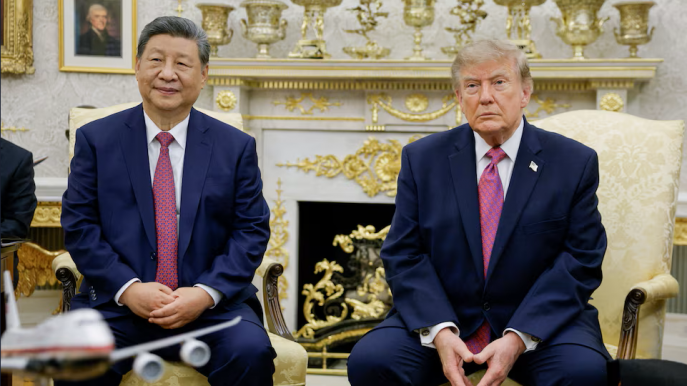
The ambassador said Trump raised the subject with Xi during the Chinese leader’s visit to Washington last week. He described Trump as noting that the United States supplies military equipment to countries across the globe before asking Xi whether China would be interested in buying US arms.
“The US sells arms to countries around the world,” Trump told Xi before asking whether China wanted to buy any, Perdue said.
Perdue did not say precisely when the conversation occurred, nor did he describe Xi’s reaction. Trump has not publicly discussed the reported question since the summit.
White House and State Department Reject Any Arms-Sale Plan
After Perdue’s interview, the White House said there was no plan to sell weapons to China. The State Department likewise stated that US law bars arms sales to Beijing and said no proposal or offer to provide weapons to China existed.
The clarification underscored the unusual nature of the reported exchange. China is a major military power and a strategic competitor of the United States, while American law and policy place strict limits on defence trade with Beijing. The remarks also arrived at a sensitive moment for Taiwan, whose defence requirements remain a central point of disagreement between the US and China.
Trump has previously called the prospective Taiwan package a “very good negotiating chip” in relations with China. That description has added to questions over the timing and purpose of a decision that Taiwan has been waiting months to receive.
On Saturday, 26 September, Trump said only that Xi understood his position on Taiwan. Perdue, speaking to CNBC on Friday, said there had been no alteration in Trump’s Taiwan policy, including the administration’s stance on weapons sales to the island.
Taiwan Remains at the Center of US-China Friction
The United States has for decades followed a policy often described as strategic ambiguity on Taiwan. Washington has not made an unqualified public commitment to intervene militarily should China attack the island, leaving uncertainty about the exact circumstances in which US forces might act.
At the same time, the Taiwan Relations Act requires the United States to make defence articles available to Taiwan so it can sustain its ability to defend itself. That framework does not amount to a formal mutual-defence treaty, but it remains a cornerstone of US ties with Taipei and a continuing source of anger in Beijing.
China considers Taiwan a breakaway province and says the island is part of its territory. Chinese authorities have consistently objected to US arms transfers and defence contacts involving Taiwan, arguing that such activity interferes in China’s internal affairs and encourages forces supporting Taiwanese independence.
During his Washington visit last week, Xi urged Trump to oppose “Taiwan independence,” China’s state-run Xinhua news agency said. The appeal reflected Beijing’s longstanding position that the future of Taiwan is a matter of core national interest.
For Taiwan, however, access to defensive equipment is tied directly to its assessment of the military balance across the Taiwan Strait. Deputy Foreign Minister Chen Ming-chi said separately that the threat posed by China remained severe. He said Beijing was continuing to develop and enlarge its military capabilities despite economic difficulties.
What the Proposed Package Could Mean
The reported $14 billion package has become significant not simply because of its size, but because it would signal the direction of US support for Taiwan at a time of rising regional uncertainty. Any new sale would likely strengthen Taiwan’s capacity for self-defence, while also prompting renewed objections from China.
Arms transfers to Taiwan regularly carry consequences beyond the equipment itself. They affect diplomatic exchanges between Washington and Beijing, shape military planning in the region, and are watched closely by Taiwan’s leaders as an indication of American commitment. Delays can also take on political importance, particularly when larger negotiations between the US and China are under way.
Perdue’s account introduced another layer of uncertainty by suggesting that Trump used the subject of weapons sales in a direct conversation with Xi. Yet the later statements from the White House and State Department made clear that the United States was not preparing to supply arms to Beijing.
The episode leaves the central policy questions unchanged. Taiwan is awaiting movement on the proposed defence package, China remains firmly opposed to US military support for the island, and Washington continues to balance its legal obligations to Taiwan with its effort to manage a difficult relationship with Beijing.
For now, the administration’s public position remains that its Taiwan policy has not shifted. But the ambassador’s remarks demonstrate how quickly the issue of arms sales can become entangled with the broader and increasingly consequential relationship between the world’s two largest powers.
Related Reading
Frequently Asked Questions
What is Trump asked Xi if China wanted?
Trump asked Xi if China wanted is the main topic of this guide. The article explains the context, practical details, and next steps readers should understand.
Why does Trump asked Xi if China wanted matter?
Trump asked Xi if China wanted matters because readers are looking for a useful answer, not just a short summary. Good content should match search intent and help them decide what to do next.