Seven Artists, Six Guests, and the Stories That Paintings Alone Cannot Carry
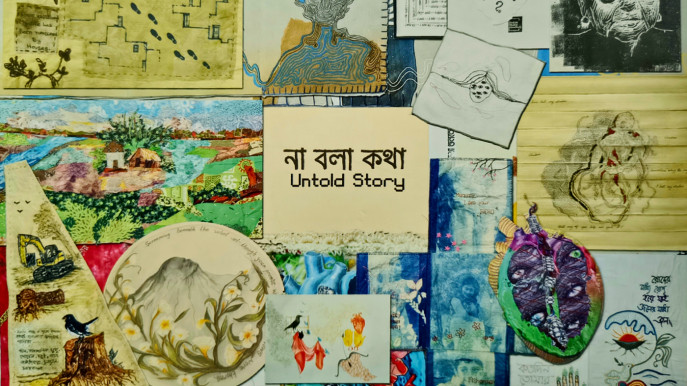
Bdbusinessdaily.com – Walk into what you expect to be a conventional painting show, and instead find yourself confronted with stitched textiles, hand-written poems, fabric-bound books, and collages that demand you slow down, turn pages, and sit with someone else’s most private grief. That is the experience waiting at “Untold Story,” a mixed-media exhibition running from 1 to 9 September at Alliance Française de Dhaka. The show is assembled around a core collective of seven artists joined by six guest contributors, each of whom has spent considerable time developing layered, multi-material methods of narrative that flat canvases simply cannot replicate.
What distinguishes this gathering from a typical contemporary art display is not merely the technical ambition of the pieces. It is the degree to which each work functions as an autobiographical confession. The artists thread their own vulnerabilities, family histories, and unresolved emotional wounds directly into the fabric of the objects. The result is an impact that does not land uniformly; it echoes differently in every viewer, lingering in ways that resist a single interpretive frame.
The Book as Bridge Between Image and Life
Most works in the exhibition arrive paired with an experimental book — constructed from cloth, paper, or both — that weaves together paintings, collages, stitchwork, textiles, handwritten passages, and poetry. These volumes are not decorative appendages. They function as narrative engines, pulling the viewer from the visual surface into the artist’s interior world. Family photographs appear beside memories; the life the maker has actually lived surfaces alongside the life they have rendered in pigment and thread. The effect, as one might expect from such intimacy, can be disorienting. That disorientation, however, is arguably the exhibition’s most powerful quality. It severs the comfortable distance between audience and object, transforming what would otherwise be an objective commentary on contemporary art into something closer to a window onto the artists themselves.
Grief Set Against a Nation’s Decay
No work in the show makes the personal-political entanglement more explicit than Snulekha Chowdhury’s contribution. Her piece confronts the acute grief of watching her mother receive a cancer diagnosis in 2024, layered against the backdrop of a country she perceives as sliding deeper into institutional corruption. In that compressed moment, she describes memories of her mother — the love, the despair, the loss, the sense of belonging — collapsing into a single feeling for which no adequate language exists.
One side of the work presents a small box holding dozens of cancer medications, their caps colour-coded, yet utterly powerless against the weight that descends without warning. Each pill, in her telling, becomes a countdown attached to a parent’s remaining time. The opposite side opens a fabric-bound book populated with young photographs of her mother, celebrating a life running parallel to the disease consuming it. The juxtaposition is deliberate and unflinching.
Intergenerational Bonds and the Cycle of Love
Several other pieces pivot from individual grief toward the unbreakable cycles of love, obligation, and burden that pass between generations. Sumana Akter’s work titled “The Story Within Us” examines motherhood — the moment when a person’s entire orbit, almost overnight, reconfigures to revolve around her children. Crucially, Akter does not frame this transformation as a stripping of individuality. Instead, she positions it as the continuation of an intergenerational cycle of love, a bond she characterises as the one connection in life that genuinely never fades, even as everything surrounding it shifts or vanishes.
The accompanying book becomes a space to circle back to that constant presence, much like revisiting a memory you already know by heart yet still feel compelled to hold onto. The repetition is not redundancy; it is ritual.
Urban Planning as Horror Story
The exhibition’s scope extends beyond individual and collective consciousness into civic critique. Rafia Mahjabeen’s “Panthakunja” operates as an acting commentary on what she frames as the insatiable horror of urban planning executed at the expense of ordinary people under the banner of development. The work centres on a site that once served as refuge for people, plants, and animals, before approximately 2,000 trees were felled to make way for an elevated expressway. Through natural dyes, eco-printing, and hand stitching, Mahjabeen layers fabric, colour, and detail to reconstruct the trees, people, and other life forms that once shared that ground. The implicit question presses outward: what becomes of those relationships when the city continues to carve less and less room for nature?
Home as Fragment, Memory as Kinetic Object
Among the standout works, Rituparna Saha’s “In Search of My Home” draws particular attention. Accompanied by her own book, Saha narrates the experience of seeking belonging in places, shaped by a childhood spent in rented houses and constant relocation. Through textiles, photographs, drawings, and hand-stitched flowers, the piece clings to fragments of locations left behind. It poses the question of whether home is genuinely a fixed coordinate or something carried internally, persisting regardless of geography.
Mahmuda Siddika’s “Bari-r Tane” takes a different formal approach, converting a train journey into a kinetic object. The viewer is invited to turn handle rolls, pushing the landscape forward and viewing the unfolding scene as a mechanical narrative. The work transforms passive observation into physical participation, making the act of witnessing itself a small act of storytelling.
Why This Matters in Dhaka’s Contemporary Scene
Alliance Française de Dhaka has long served as a crossroads for francophone and South Asian artistic exchange, and “Untold Story” extends that mission into territory where the boundary between gallery object and personal diary dissolves entirely. In a city where rapid infrastructure projects routinely displace communities and natural habitats, and where the political climate of 2024 sharpened public anxieties about institutional failure, an exhibition that insists on the specificity of individual grief while simultaneously interrogating collective structures of power carries particular urgency. The mixed-media format — stitching, eco-printing, natural dye, fabric construction — also positions these works within a broader South Asian tradition of textile-based storytelling, where cloth has long carried memory, mourning, and identity in ways that oil paint never could.
The exhibition closes on 9 September. What it leaves behind, for those who take the time to sit with each stitched page and each colour-coded pill, is not a tidy thesis but a residue: the sense that someone’s most private story has briefly occupied the space where your own used to be, and that the overlap, however uncomfortable, is precisely the point.
Related Reading
Frequently Asked Questions
What is Untold Story?
Untold Story is the main topic of this guide. The article explains the context, practical details, and next steps readers should understand.
Why does Untold Story matter?
Untold Story matters because readers are looking for a useful answer, not just a short summary. Good content should match search intent and help them decide what to do next.