Nahid Islam Calls on Tarique Rahman to Choose How He Leaves Office
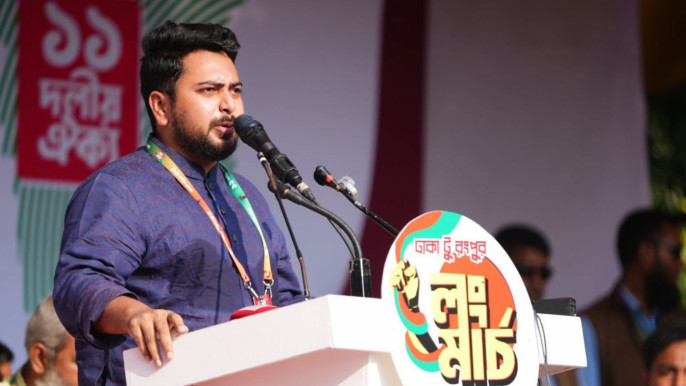
Bdbusinessdaily.com – Speaking at the opening gathering of the Jamaat-e-Islami-led opposition alliance’s Dhaka–Rangpur long march, National Citizen Party convener and opposition chief whip Nahid Islam issued a sharp challenge to Prime Minister Tarique Rahman over the future of his government.
The rally took place on Manik Mia Avenue in the capital on the morning of 19 September, as opposition groups began their march with a broad set of political and economic demands. Nahid said the prime minister must determine whether he intends to step down respectfully or depart the country under pressure.
“Tarique Rahman has to decide how he will leave power. Will he flee the country by helicopter? Or will he resign from power with dignity?”
Referring to former president Hussain Muhammad Ershad, Nahid argued that even Ershad had relinquished office with a measure of dignity. He said Tarique Rahman now faces his own decision over the path he will take.
“Even Ershad resigned with considerable dignity. So Tarique Rahman himself has to decide which path he will take.”
Claims of pressure on democratic rights
Nahid accused the BNP-led government of moving away from the democratic and human-rights principles that opposition forces had previously defended. He said activists had spent 16 years campaigning for those rights and that the BNP had once stood alongside them during that struggle.
Now, he alleged, the situation has changed since the BNP took office. Nahid claimed that the government is infringing on people’s rights and weakening democratic institutions rather than safeguarding them.
“For the past 16 years, we fought for human rights and democracy. The BNP was with us. Now that this BNP is in government, it is violating people’s human rights and destroying democracy.”
He warned that political forces responsible for damaging democracy in earlier periods had ultimately been rejected by history. In his remarks, Nahid portrayed the current political moment as another test of whether public institutions will protect citizens’ rights or be used against them.
“Those who destroyed democracy in the past have found their place in the dustbin of history.”
Nahid further alleged that the government is creating an environment in which abuses can occur. He said the administration’s responsibility should be to defend human rights, but argued that its actions are instead enabling violations.
He also accused the government of relying on laws and institutions that, he said, had previously been used during the Sheikh Hasina administration to deny people their rights. The allegation places institutional reform at the centre of the opposition’s message, alongside its demands for political accountability and economic relief.
Long march and allegations of obstruction
The Dhaka–Rangpur long march has been organised by the Jamaat-led opposition alliance as a national mobilisation effort. Nahid said the movement had already generated significant public backing in different parts of the country.
He alleged that banners and festoons promoting the programme had been removed since the night of 17 September. Nahid claimed BNP activists and the city corporation were involved in taking down the materials in various locations, describing the actions as an attempt to limit participation in the march.
“BNP activists, along with the city corporation, have joined in. These banners and festoons are being torn down in different places.”
Despite those claims, Nahid said the removal of campaign materials would not halt public support for the opposition programme. He suggested that the alliance’s separate demands would increasingly unite around a larger political call.
“Tearing down banners and festoons will not stop the mass mobilisation behind this long march. The number of demands is increasing. All the demands will eventually converge into one demand.”
Political and economic demands
The alliance’s platform combines demands related to democratic accountability with concerns affecting daily life. It is seeking implementation of the people’s mandate expressed in the referendum and trials for those held responsible for the July killings.
Its economic demands include action over shortages of electricity, oil, gas and fertiliser. The alliance is also calling for steps to prevent increases in the prices of essential goods, an issue with direct consequences for households and businesses facing higher living costs.
Other demands focus on ending corruption, extortion and land grabbing, while improving law and order. The coalition has also called for an end to what it describes as narrow partisanisation, reflecting its criticism of political influence over public institutions and civic life.
The Teesta Master Plan is included among the alliance’s stated priorities. By placing regional development and resource management alongside national political issues, the long march seeks to connect concerns in Dhaka with those affecting communities across the route toward Rangpur.
Nahid’s address set a confrontational tone for the programme, framing the march as both a protest against alleged rights violations and a campaign for a wider set of governance, accountability and economic measures. The alliance’s ability to turn those demands into sustained public mobilisation is likely to shape the political significance of the long march in the days ahead.
Related Reading
Frequently Asked Questions
What is Tarique must decide whether he will?
Tarique must decide whether he will is the main topic of this guide. The article explains the context, practical details, and next steps readers should understand.
Why does Tarique must decide whether he will matter?
Tarique must decide whether he will matters because readers are looking for a useful answer, not just a short summary. Good content should match search intent and help them decide what to do next.