Dhaka University History Department Focuses on Outcome-Based Learning
Bdbusinessdaily.com – The Department of History at Dhaka University has organised a full-day workshop aimed at helping teachers strengthen their approach to outcome-based education, with particular attention to classroom teaching and student assessment.
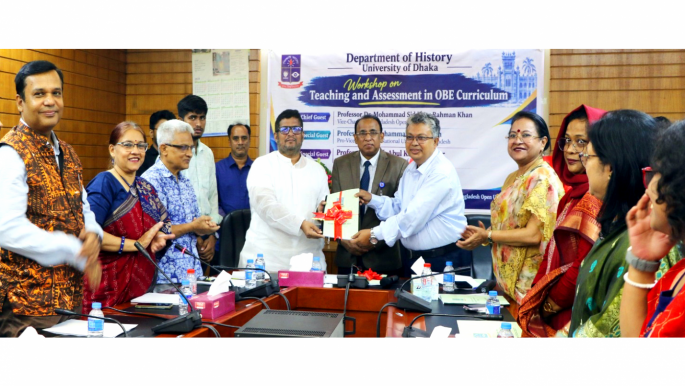
Held on 9 October, the programme was titled “Teaching and Assessment in OBE Curriculum”. It began at 10am at the vice-chancellor’s conference room of Bangladesh Open University’s Gazipur campus. The event brought together academic leaders and teachers to consider how an outcome-based curriculum can be applied effectively in history education.
Outcome-based education, commonly known as OBE, places emphasis on what students are expected to know, understand and demonstrate after completing a course or programme. For teachers, this means connecting lesson planning, learning activities and assessment methods with clearly defined academic outcomes. The workshop was designed to help participants consider those connections in a practical academic setting.
Call for Better Preparation of Teachers
Bangladesh Open University Vice-Chancellor Professor Dr Mohammad Siddiqur Rahman Khan attended the workshop as chief guest. He said that effective implementation of outcome-based education is important for developing a modern and high-quality education system.
“Proper implementation of an outcome-based education curriculum is essential to building a modern, quality education system. This curriculum will help move beyond the conventional examination- and certificate-based system, improve the quality of education, and prepare students to compete globally,” he said.
He noted that the shift creates an important challenge for teachers. Many educators have worked for years within traditional teaching and examination systems, and adapting to a framework that evaluates learning outcomes requires careful preparation.
Training sessions and workshops can therefore play a central role in helping teachers understand new methods of instruction and assessment. Rather than treating assessment only as a final examination, an outcome-focused approach encourages educators to consider whether students are developing the intended knowledge and skills throughout the learning process.
Professor Siddiqur Rahman Khan expressed hope that the daylong programme would give teachers a clearer understanding of the methods needed to teach and assess students under the OBE curriculum. He said this understanding could help them contribute more effectively to the successful implementation of the approach.
A Model for Other Academic Departments
The Bangladesh Open University vice-chancellor also highlighted the significance of the initiative being led by Dhaka University’s Department of History. He said the department’s longstanding academic tradition could help make the workshop an example for other university departments.
He thanked the department for arranging the programme and urged other departments under the Faculty of Arts to undertake similar efforts. Such initiatives can create opportunities for teachers to exchange experiences, identify challenges and develop approaches that suit the needs of their own disciplines.
For a subject such as history, teaching and assessment involve more than recalling dates, events and names. Students may also be expected to interpret evidence, examine competing perspectives, build arguments and communicate their understanding clearly. Aligning teaching methods and evaluation practices with such outcomes can help ensure that academic expectations are visible to both teachers and learners.
The workshop’s focus on assessment was especially relevant because the way students are evaluated can shape how they learn. If learning outcomes call for analysis, interpretation and thoughtful use of historical material, assessments need to give students meaningful opportunities to demonstrate those abilities.
Faculty of Arts Participation
Professor Dr Md Abul Kalam Sarker, dean of the Faculty of Arts at Dhaka University, attended the workshop as special guest. He said that introducing the outcome-based curriculum would support the History Department in maintaining its established academic tradition.
He also stressed the value of drawing on the experience and skills of teachers who have served as master trainers for the University Grants Commission. Their knowledge can be useful in helping colleagues interpret the requirements of the curriculum and put them into practice in teaching and evaluation.
Professor Abul Kalam Sarker said the workshop could help participants recognise existing gaps and limitations in classroom teaching and student assessment. Identifying those issues is an important first step toward improving academic practice, since a curriculum can only achieve its intended goals when teachers have suitable tools, shared understanding and workable assessment methods.
He voiced optimism that the programme would contribute to further improvements in educational quality while supporting the Department of History’s academic legacy.
Why the Discussion Matters
The workshop reflected a wider need within higher education to ensure that curriculum goals are translated into everyday teaching. A written curriculum establishes expectations, but its impact depends on how those expectations are understood in classrooms, course assignments and examinations.
For teachers, discussions on outcome-based education can clarify questions such as what students should achieve by the end of a course, how classroom activities can support those goals, and what forms of assessment can fairly measure progress. For students, clearer learning outcomes can make academic expectations easier to understand and can show how individual assignments relate to broader educational objectives.
The Department of History’s initiative brought these issues into focus through a dedicated day of academic discussion. By involving university leaders, faculty representatives and teachers, the workshop created space to examine both the promise of outcome-based education and the practical work needed to implement it successfully.
As departments refine their approaches to teaching and assessment, programmes of this kind can help educators move from broad curriculum goals to methods that are meaningful in the classroom. The workshop at Bangladesh Open University’s Gazipur campus marked an effort by Dhaka University’s History Department to advance that process through professional learning, reflection and collaboration.
Related Reading
Frequently Asked Questions
What is DU history department holds workshop on outcome?
DU history department holds workshop on outcome is the main topic of this guide. The article explains the context, practical details, and next steps readers should understand.
Why does DU history department holds workshop on outcome matter?
DU history department holds workshop on outcome matters because readers are looking for a useful answer, not just a short summary. Good content should match search intent and help them decide what to do next.