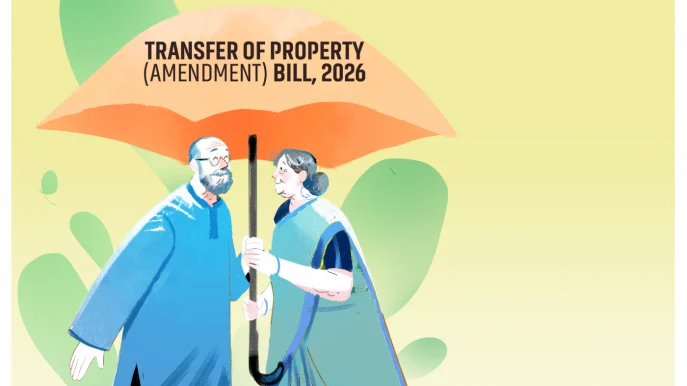
A New Property Option for Lifetime Security
Bdbusinessdaily.com – Bangladesh has introduced a new legal mechanism intended to protect elderly people who transfer property to close family members but still need a secure place to live and a dependable source of support. The Transfer of Property (Amendment) Bill, 2026 creates a “Gift reserving life interest,” allowing a donor to pass on ownership while retaining defined rights over the property during their lifetime.
The reform responds to a recurring hardship faced by older parents: after signing away land or a home, they may lose not only ownership but also the ability to remain on the premises or benefit from its income. For many families, property is the principal asset accumulated over a lifetime, making an unconditional transfer especially risky when care arrangements later collapse.
Cases that show the vulnerability
In Sheikh Sadi village in Jamalpur, 75-year-old Yad Ali had supported himself through earth-cutting work and banana sales. Age and disability eventually made that work impossible. His younger son, Umar Farooq, offered to care for him in return for two decimals of land. Yad Ali later discovered that the transfer covered the full 39.5-decimal homestead.
After seeking cancellation of the deed through the courts, Yad Ali and his wife were allegedly beaten with sticks by his son and daughter-in-law and forced out of their home. He now survives by begging.
Another dispute brought 84-year-old Barik Gazi and his 78-year-old wife, Shar Banu, to the office of the Upazila Nirbahi Officer in Keshabpur, Jashore. Unable to walk, the couple were transported in a hired van by their four daughters, who submitted a written complaint against their two sons.
Their younger son, Sayeed Gazi, had taken Barik Gazi to Keshabpur for medical treatment the previous year. During that trip, 24 decimals of land were registered in the son’s name. A local union parishad mediation did not resolve the conflict. The couple’s elder son, Sajjat Gazi, later demolished their residence and evicted them.
Such experiences illustrate why an outright transfer can leave an elderly donor exposed. Under the previous operation of the Transfer of Property Act, 1882, and traditional personal-law gift arrangements such as Heba, a donor generally surrendered ownership and possession immediately. Once the deed was completed, parents could become reliant on their children’s willingness to continue housing or supporting them.
What the amendment changes
The amendment adds Sections 122A and 122B to the 1882 law. It does not replace existing personal laws or make this form of transfer compulsory. Instead, it opens an additional civil-law route for people who wish to give property to family members without abandoning their own lifetime interests.
Section 122A permits parents and grandparents to transfer property to children or grandchildren while reserving rights to live in, use and enjoy the property for the rest of their lives. Spouses may also make such transfers to one another. The retained interest can include the right to occupy the property as well as the right to receive rent or other income generated from it.
For land, houses and other immovable property, the lifetime reservation must be written clearly into a registered deed. That requirement is important because it places the donor’s continuing entitlement in the formal property record rather than leaving it to an informal family promise.
The protection continues even if the recipient dies before the person who made the gift. In that situation, ownership moves to the recipient’s legal heirs, but the donor’s right of occupancy and enjoyment remains in force for the donor’s lifetime.
Rules on changing or cancelling the deed
Section 122B provides that a registered gift with a reserved life interest cannot be cancelled by one party acting alone. However, the donor and recipient may jointly amend or revoke the arrangement through another registered deed when there is a genuine financial, medical or family need.
If either party is legally incapable of participating in that decision, approval from a district judge is required. The provision seeks to balance stability in registered transfers with the practical reality that illness, changing household circumstances or financial pressure can require an arrangement to be reconsidered.
Law Minister Md Asaduzzaman has described the measure as an optional parallel route designed to protect vulnerable older parents while leaving existing personal-law systems unchanged.
Why the distinction matters
The central legal change is the separation of ownership from usufruct—the ability to use property and receive its benefits. A child or grandchild may acquire ownership, while the older donor retains the legal right to remain in the home or collect income from it. This gives families a way to plan succession without requiring an elderly person to surrender every practical safeguard at once.
Legal observers have described the reform as a meaningful social-security measure, particularly for parents and women whose financial security may depend on access to a home, land or rental income. The measure is also relevant where property is transferred in anticipation of care, since the donor’s continued rights no longer depend solely on a recipient’s personal commitment.
The amendment addresses a significant problem. Before the amendment, once a parent made a gift or Heba of their property, they lost both ownership and possession entirely, and any legal claim over how the property was used or enjoyed.
Supreme Court senior advocate and human-rights activist Barrister Sara Hossain said the earlier position left many older donors without meaningful security after a transfer.
This left many elderly parents dependent entirely on their children’s goodwill once the transfer was made, with no security if that support did not follow.
The new framework does not guarantee that family disputes will disappear, nor does it undo transfers already made under different arrangements. Its significance lies in providing a clearer choice before a deed is signed. A person considering a transfer can now preserve lifetime residence, use and income rights through a registered instrument.
For families, the practical lesson is that a property gift should be treated as more than a private understanding. The exact terms of occupation, income and future modification should be addressed in the registered deed. By giving legal force to those protections, the amendment aims to ensure that transferring property does not mean giving up dignity, shelter or independence in old age.
Related Reading
Frequently Asked Questions
What is Bangladesh s property law amendment puts?
Bangladesh s property law amendment puts is the main topic of this guide. The article explains the context, practical details, and next steps readers should understand.
Why does Bangladesh s property law amendment puts matter?
Bangladesh s property law amendment puts matters because readers are looking for a useful answer, not just a short summary. Good content should match search intent and help them decide what to do next.