Strait of Hormuz Standoff: Tehran and Washington Publish Rival Accounts of Naval Strikes
Bdbusinessdaily.com – The narrow waterway that funnels roughly one-fifth of the world’s daily oil supply has once again become the flashpoint of a tit-for-tat exchange between Iran and the United States. On Wednesday, both sides issued sharply contradictory statements about missile salvos, shipboard damage, and tanker strikes in and around the Strait of Hormuz, leaving observers without independent confirmation of what actually transpired on the water.
Tehran’s Version of Events
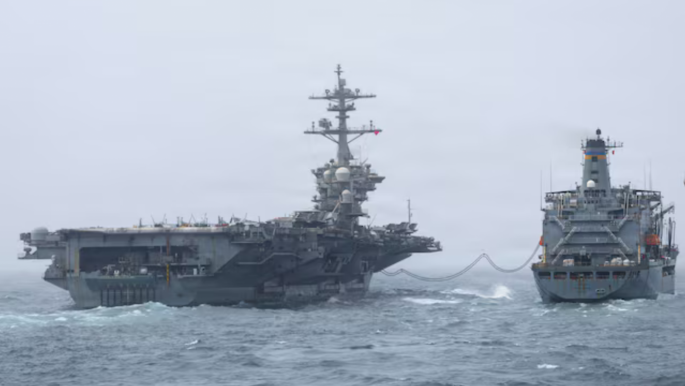
The Islamic Revolutionary Guard Corps announced that it had fired ballistic missiles at two American naval vessels operating close to the strait: an aircraft carrier and a destroyer. According to the IRGC statement, both ships sustained damage and subsequently pulled out of the operational area. Tehran framed the salvos as a proportional reply to what it characterized as sustained American harassment of Iranian-flagged shipping and Washington’s role in enforcing a maritime blockade against Iranian trade.
In a separate communiqué, the IRGC Navy detailed additional targets. The unit said it struck a remotely piloted American military craft that had been trying to push into what Tehran described as a protected maritime zone. The same statement claimed that three oil tankers transiting the strait were hit, along with three vessels linked to the United States operating in other sectors of the region.
The IRGC closed its briefing with a pointed warning: the waterway, it insisted, remained firmly under Iranian command, and any further American military maneuvering in the vicinity would be met with force.
Washington’s Counter-Narrative
US Central Command (CENTCOM) pushed back on nearly every element of the Iranian account. The Pentagon’s regional command acknowledged that ballistic missiles had been launched in the direction of two US Navy ships, but it stated that both vessels maneuvered to avoid the projectiles. CENTCOM emphasized that no American service member was injured in the episode.
Where the two accounts diverged most sharply was over the tankers. CENTCOM announced that US forces had struck three Iranian crude-oil tankers in the area — a claim that inverts the direction of responsibility Tehran assigned. In Washington’s telling, it was American ships that did the hitting, not Iranian missiles.
Neither side released footage, sensor data, or third-party corroboration that would allow independent verification. Shipping registries, satellite imagery providers, and neutral maritime authorities had not, as of the latest updates, confirmed either version of the tanker strikes or the extent of any hull damage to carrier or destroyer.
Why the Strait Matters
The Strait of Hormuz is the single most consequential chokepoint in global energy logistics. At its narrowest point the channel is roughly 33 kilometres wide, and the active shipping lanes on either side are only a few kilometres broad. Approximately 20 million barrels of crude and refined products per day — roughly one-fifth of global consumption — transit the waterway, bound primarily for markets in East Asia. Qatar’s liquefied natural gas exports also depend on the strait, adding a second strategic dimension to any disruption.
Iran has long positioned itself as the natural gatekeeper of the passage. Its coastline borders the northern shore, and it has periodically deployed fast-attack craft, mines, and short-range missiles to project control over the lanes. The IRGC Navy maintains a network of coastal batteries and small-boat units specifically tasked with interdicting or harassing commercial and military traffic. Washington, for its part, has kept carrier strike groups and destroyer escorts in the Persian Gulf and adjacent waters for decades, treating freedom of navigation through the strait as a non-negotiable commitment to its allies and to the global oil market.
Implications and What Comes Next
When two nuclear-armed states publish mutually exclusive battle reports over the same hours of combat, the diplomatic and market consequences can outpace the military ones. Oil futures typically react within minutes of any confirmed or even alleged strike on tankers in the Gulf, and insurers raise war-risk premiums quickly when the fog of competing claims thickens. Shipping companies may reroute around the Cape of Good Hope, adding weeks to voyage times and tightening supply in Asian refineries.
For Tehran, the insistence that the strait remains “under Iranian control” is both a military posture and a negotiating lever. It signals that any future talks — whether over a nuclear deal, sanctions relief, or regional security arrangements — will be conducted from a position of demonstrated reach. For Washington, the CENTCOM rebuttal is designed to reassure Gulf allies, calm commodity markets, and preserve the narrative that American naval power remains unchallenged in the waterway.
Until independent verification arrives — whether through satellite passes, port inspections, or a mutual de-escalation that allows both sides to inspect their own ships — the Strait of Hormuz will continue to operate under a cloud of competing claims, each calibrated to serve a different domestic and diplomatic audience.
Related Reading
Frequently Asked Questions
What is Iran US trade competing claims over?
Iran US trade competing claims over is the main topic of this guide. The article explains the context, practical details, and next steps readers should understand.
Why does Iran US trade competing claims over matter?
Iran US trade competing claims over matters because readers are looking for a useful answer, not just a short summary. Good content should match search intent and help them decide what to do next.