Islami Bank and National Bank post combined losses of Tk6,303 crore in nine months
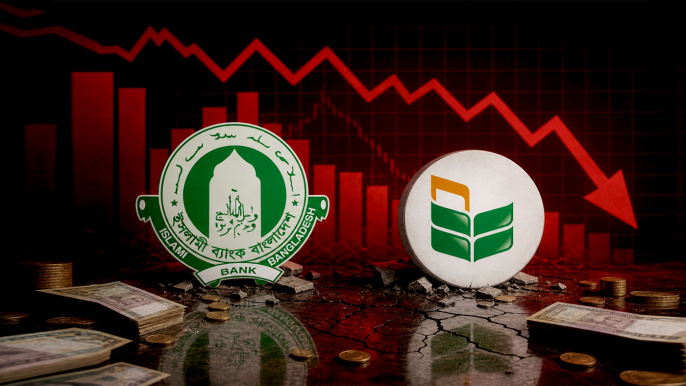
Bdbusinessdaily.com – Two of Bangladesh’s earliest private-sector banks have recorded a combined loss of more than Tk6,303 crore during the first nine months of 2026, highlighting the pressure that bad loans, weak income from investments and rising deposit costs are placing on their financial positions.
Islami Bank Bangladesh posted a consolidated loss of Tk3,286 crore for January through September, while National Bank recorded a Tk3,016.89 crore loss over the same period. The figures were disclosed after both lenders held board meetings on Thursday to approve their financial statements. Their nine-month results appeared in newspapers on 30 October to comply with regulatory requirements, although detailed quarterly statements had not yet been released in full.
Islami Bank moves from profit to steep loss
The result marks a dramatic deterioration for Islami Bank. During the first nine months of 2025, the bank had generated consolidated profit of roughly Tk100 crore. A year later, it had moved into a Tk3,286 crore consolidated loss.
Its standalone result, which excludes subsidiaries, showed an even larger loss of Tk3,302.57 crore. The July-September period was particularly difficult, with the bank losing Tk1,970.18 crore in that quarter alone.
The lender linked the reversal primarily to reduced income from investments and higher profit payments to depositors. Its explanation pointed to a continuing burden of classified and non-performing investments, including large legacy exposures connected to alleged fund embezzlement by related parties. Such troubled investments have restricted the bank’s ability to recognise income.
The decline in investment [income reflects] the continuing high level of classified or non-performing investments, mostly due to embezzlement of funds by connected parties against large legacy exposures and the consequent constraints on income recognition from such investments.
The bank also said that profit paid on deposits had risen despite a lower deposit base at the end of the period.
Again, profit paid on deposits also increased despite the decline in the period-end deposit base.
Investment income is central to an Islamic bank’s earnings model, so the inability to recognise returns from troubled investments can have a substantial impact on overall profitability. At the same time, higher payments to depositors increase the cost of maintaining funding, creating pressure from both sides of the balance sheet.
Islami Bank said it has begun measures aligned with recent Bangladesh Bank guidance. The stated priorities include strengthening capital, improving asset quality, speeding up recovery of investments and increasing income generation.
These measures are expected to contribute positively to the bank’s future earnings.
Cash flow turns negative
The bank’s operating cash flow also weakened sharply in the nine months ending 30 September 2026. Cash flow per share fell into negative territory at Tk36.54, reversing the positive position seen previously.
It attributed the decline largely to unusual deposit withdrawals during the third quarter. Deposit withdrawals can put immediate strain on a bank’s available liquidity even when its reported balance-sheet position is being addressed through longer-term recovery and capital measures.
In response, Islami Bank said it is working to boost deposit mobilisation, maintain sufficient liquidity and improve operating cash flow under regulatory guidance. The bank had earned Tk136 crore in 2025 but did not announce a dividend for that year.
National Bank’s losses nearly double
National Bank’s financial strain also deepened during the January-September period. Its Tk3,016.89 crore loss was almost double the Tk1,448.42 crore loss recorded in the corresponding period a year earlier. In the earlier period, its loss per share stood at Tk4.50.
By the end of June 2026, National Bank had already accumulated a loss of Tk2,283.85 crore. That means the bank incurred an additional Tk733.04 crore loss during the July-September quarter.
The lender said it was unable to recognise interest income on certain loans and advances because they had become classified and remained unrecovered. It also faced increased interest expenses on deposits and borrowings, adding to the erosion of earnings.
Consequently, the period concluded with an operating loss, with significant deviations observed in earnings per share and net asset value. On the other hand, deposit withdrawals declined compared with the previous year due to the regaining of customers’ confidence.
The reference to lower withdrawals suggests an improvement in depositor behaviour compared with the previous year, although it does not remove the underlying challenge posed by classified loans and unrecognised income. Recovering loans and restoring regular income remain important to reversing the operating loss.
Years of accumulated losses
National Bank’s latest result extends a period of sustained losses that began in 2022. From 2022 through September 2026, cumulative losses reached Tk11,914.17 crore.
Of that total, Tk8,897.28 crore was incurred across the four full years from 2022 to 2025. The first nine months of 2026 added a further Tk3,016.89 crore, underlining the scale of the bank’s current financial challenge.
The bank resumed full banking services in mid-October, as customers began both withdrawing and depositing funds and opening letters of credit. Customers were again able to withdraw money as needed through branches and ATMs, while some branches resumed taking fresh deposits into business accounts.
For depositors, borrowers and investors, the disclosed losses make asset recovery, liquidity management and the rebuilding of confidence especially important. Both banks have identified troubled loans and the cost of funding as major constraints, while their future performance will depend heavily on whether recovery efforts, capital-strengthening measures and deposit initiatives translate into more stable earnings.
Related Reading
Frequently Asked Questions
What is Islami Bank National Bank suffer massive?
Islami Bank National Bank suffer massive is the main topic of this guide. The article explains the context, practical details, and next steps readers should understand.
Why does Islami Bank National Bank suffer massive matter?
Islami Bank National Bank suffer massive matters because readers are looking for a useful answer, not just a short summary. Good content should match search intent and help them decide what to do next.