Building Lasting Space for Youth in Democratic Renewal
Bdbusinessdaily.com – Young Bangladeshis are taking on a broader role in public life, from helping vulnerable families access support to addressing misinformation and encouraging dialogue in communities facing social strain. Yet speakers at a recent roundtable stressed that these efforts will struggle to endure if youth participation remains tied only to time-limited projects.
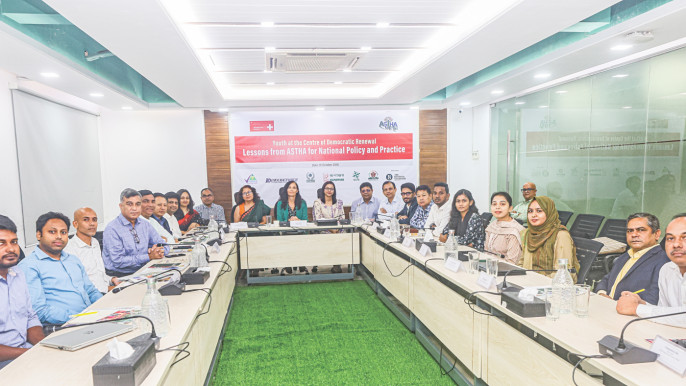
The discussion, titled “Youth at the Centre of Democratic Renewal: Lessons from ASTHA for National Policy and Practice,” was held on 15 October by ASTHA and The Business Standard. Participants from community organisations, academia and youth groups examined how local initiatives could help shape longer-term national approaches to democratic participation and inclusive governance.
ASTHA, supported by Switzerland, operated in 18 districts between July 2023 and March 2026. The programme involved roughly 4,410 young people through 147 youth forums, alongside 540 civic leaders working through 18 district civic platforms. Its activities ranged from voter registration and community conversations to peacebuilding work and training intended to help participants recognise false or misleading material online.
The central message was that young people should be treated as contributors to public life, not simply as recipients of development assistance. For that to happen, participants argued, youth groups need reliable financing, closer connections with institutions and real channels through which local concerns can influence decisions.
Grassroots work reaches women and vulnerable residents
Champaklota Das, a youth leader with the ASTHA group in Kolaroa, Satkhira, described how local action can produce practical benefits for residents. After joining ASTHA in 2023, she helped 32 women gain access to training in sewing, tailoring and beauty services.
She also said livestock-related training helped two people begin businesses through loans. Her group distributed 100 saplings and assisted elderly residents and widows in applying for social safety-net benefits without charging them for the support.
Such activities demonstrate how youth forums can connect people with skills, services and opportunities that may otherwise remain difficult to reach. At the same time, Das pointed to political interference as a continuing obstacle. Community leaders can find it hard to maintain initiatives when local pressures affect grassroots work, making stronger institutional protection especially important.
Education and representation remain key concerns
Jiyana Madrajee, a youth leader from Kamalganj in Moulvibazar, focused attention on the needs of tea garden communities. Kamalganj contains 23 tea gardens, and some of these communities do not have access to government primary schools.
His youth group received a Tk100,000 grant from the Ministry of Youth and Sports for its work. In addition, four of its members have seats on the National Youth Council, creating a route for local issues to be placed before a national platform.
Madrajee said young people living in tea garden areas require stronger access to education, public services and decision-making spaces. Representation is valuable, but it must be paired with responsive institutions capable of addressing the concerns that young leaders bring forward. A place at the table has the greatest value when it can lead to action beyond the meeting room.
Peacebuilding requires early engagement
Ripan Chakma, executive director of Trinamul Unnayan Sangstha, said Bangladesh cannot fully achieve the Sustainable Development Goals while the Chittagong Hill Tracts are left behind. He identified social cohesion and meaningful youth participation as essential in an area where misinformation, drug abuse and communal tension can place communities under pressure.
The violence of September 2024, followed by human chains calling for peace, showed both the risks of rising tension and the importance of intervening before conflict worsens. Chakma said ASTHA has helped young people from different backgrounds develop greater mutual understanding, but argued that the work needs wider reach and dependable backing.
He also highlighted the importance of systems that can identify warning signs early, before disputes turn into larger confrontations. Youth groups can be part of that process because they are often close to the communities where tensions emerge. Their capacity to promote dialogue, however, depends on access to support, trusted local partnerships and safe opportunities to take part in public affairs.
ASTHA’s non-partisan approach was presented as one way to create bridges across social and political divisions. Sustaining unity, Chakma suggested, will require government support for youth-led activities as well as for the local organisations that help those activities continue.
Participation must connect to livelihoods
Dr. Kazi Maruful Islam, a professor of Development Studies at Dhaka University, argued that youth engagement cannot be sustained by civic programmes alone. Young people must be recognised as citizens with their own capacity to act, rather than being viewed only as beneficiaries of development projects.
Civic education, peacebuilding and social-cohesion efforts can strengthen confidence and encourage participation. But Dr. Islam stressed that these forms of engagement also need connections to employment, skills development and economic opportunity. Without pathways to improve their material circumstances, many young people may find it difficult to remain involved in community and democratic work over time.
This creates an important policy challenge. Youth initiatives should not be isolated from public services, training systems or livelihood support. A young person who learns to organise a community dialogue, identify online misinformation or help neighbours secure public assistance may also need access to skills, decent work prospects and institutions that respond to local needs.
From Short Projects to Durable Public Participation
The experience discussed at the roundtable points to a wider question for national policy: how can effective local youth engagement continue once a particular project cycle ends? The answer lies not only in grants, although funding remains important. It also involves building regular links between youth forums, local authorities, civic platforms, public services and national decision-making bodies.
Long-term institutional support would allow young leaders to plan beyond immediate activities, retain experience within their communities and develop responses to issues that cannot be resolved quickly. It could also help ensure that women, tea garden communities, residents of the Chittagong Hill Tracts and other groups facing barriers are included in democratic participation.
The work of ASTHA participants shows that youth leadership is already producing visible community-level action. The next step is to make sure those efforts are not temporary exceptions, but part of a durable system in which young people can help shape a more inclusive, peaceful and responsive Bangladesh.
Related Reading
Frequently Asked Questions
What is Youth Led Democracy Needs Long Term?
Youth Led Democracy Needs Long Term is the main topic of this guide. The article explains the context, practical details, and next steps readers should understand.
Why does Youth Led Democracy Needs Long Term matter?
Youth Led Democracy Needs Long Term matters because readers are looking for a useful answer, not just a short summary. Good content should match search intent and help them decide what to do next.