Fuel-Saving Cars Gain New Appeal as Octane Prices Climb
Bdbusinessdaily.com – For private-car owners in Bangladesh, the cost of every journey has become much harder to ignore. Octane, widely used in passenger vehicles, was priced at Tk120 per litre at the start of the year. By October, after several revisions, it had reached Tk165 per litre—an increase of Tk45, or 37.5%, in only a few months.
That change makes fuel efficiency more than a specification-sheet talking point. A car that uses less fuel in Dhaka’s traffic, or can cover daily trips with electricity, may significantly reduce the number of visits to the fuel station. The familiar reconditioned Toyota hybrid remains a practical choice, but the market now includes plug-in hybrids and Chinese range-extended electric vehicles that approach economy in a different way.
Comparisons need to be made carefully. Conventional hybrids produce electricity as they drive and do not need external charging. Plug-in hybrids can use little or no petrol during short, regularly charged trips, but their consumption changes sharply when their batteries are empty. A quoted economy figure therefore matters less than how the vehicle will actually be used: daily distance, traffic conditions, battery condition, driving habits and access to overnight charging all affect the final bill.
Toyota Aqua: The Straightforward Economy Choice
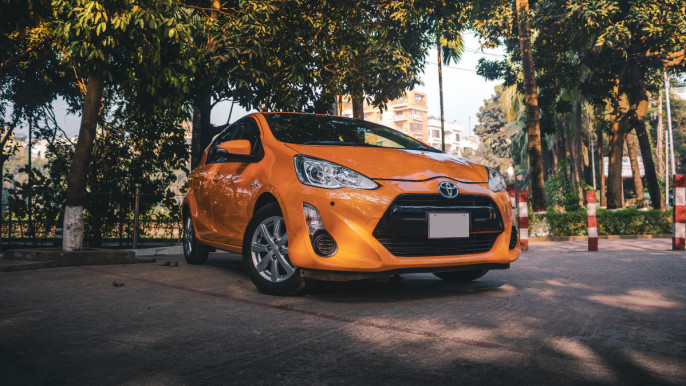
The Toyota Aqua has spent more than a decade establishing itself as one of Bangladesh’s most recognisable fuel-efficient cars. First-generation models commonly seen locally use a 1.5-litre Atkinson-cycle petrol engine paired with an electric motor. Their combined output is about 99 hp, so rapid acceleration is not the central appeal.
Its strength is efficiency. An Aqua in good condition can generally deliver around 22 to 24 kilometres per litre, although the result will vary with congestion, maintenance, battery health and the driver’s behaviour. This is where the hybrid system is particularly useful in city traffic. Frequent braking allows regenerative braking to recover energy that would otherwise be lost.
There is also no charging routine to manage. Owners simply refuel and drive, while the hybrid system handles the switching between petrol and electric assistance. It is not designed to be glamorous or especially thrilling, but its modest appetite has become far more attractive with octane at Tk165 per litre.
Toyota Prius: More Room Without a Major Fuel Penalty
Drivers who need a larger, more comfortable car can look to the Toyota Prius. The fourth-generation Prius, especially models from 2016 to 2021 that are widely found in the reconditioned market, combines Toyota’s hybrid technology with a 1.8-litre petrol engine. Total output is roughly 121 bhp.
That performance level is sufficient for everyday motoring rather than dramatic acceleration. In return, the Prius brings more cabin space, comfort and highway composure than the smaller Aqua. It can serve as a family car without the fuel demands normally associated with a larger petrol sedan or a 2.5-litre SUV.
In dense urban conditions, local Prius examples can achieve approximately 15 km/l. Longer journeys and careful driving can improve that figure. For buyers who want a conventional refuelling experience, useful passenger space and strong efficiency, the Prius remains a compelling middle ground. Its long-running reputation as a symbol of hybrid motoring now looks less like a novelty and more like a sensible response to higher operating costs.
BYD Sealion 5 DM-i: Efficiency Depends on Charging Habits
The BYD Sealion 5 DM-i illustrates how quickly economical motoring is changing. This plug-in hybrid SUV pairs a 1.5-litre petrol engine with an electric motor, delivering 156kW—about 212 hp—and 300Nm of torque. That gives it considerably stronger performance than the smaller Toyota hybrids while retaining the potential for low day-to-day fuel use.
The Bangladesh-market version offers up to 71 kilometres of electric-only travel and a claimed overall range of around 1,000 kilometres. International WLTP ratings place weighted combined fuel consumption between 2.1 and 2.7 litres per 100 kilometres, equivalent to at least 37 km/l. Those numbers, however, assume that the battery is charged regularly.
For a person travelling 30 to 40 kilometres each day and connecting the vehicle to a charger overnight, the petrol engine may see very limited use through much of the working week. Once the battery charge is depleted, fuel consumption naturally increases. The Sealion 5 therefore makes most sense for buyers whose routine includes reliable charging rather than those who expect hybrid-like figures without plugging in.
Choosing the Right Type of Economy
The most economical option is not automatically the one with the lowest advertised fuel-consumption number. An Aqua may suit someone who wants uncomplicated efficiency in heavy traffic and has no home charger. A Prius provides a more spacious alternative for families and frequent highway users. The Sealion 5 DM-i offers the possibility of electric commuting with the flexibility of a petrol engine for longer distances, provided charging is part of everyday life.
Before purchasing, buyers should consider their normal weekly mileage, the condition of a reconditioned hybrid battery, expected traffic conditions and whether charging is conveniently available. With fuel prices rising so sharply, the best car may be the one whose technology fits the owner’s real routine—not merely the one with the most impressive claim on paper.
Related Reading
Frequently Asked Questions
What is 5 economical cars to beat rising?
5 economical cars to beat rising is the main topic of this guide. The article explains the context, practical details, and next steps readers should understand.
Why does 5 economical cars to beat rising matter?
5 economical cars to beat rising matters because readers are looking for a useful answer, not just a short summary. Good content should match search intent and help them decide what to do next.