CUET Students Reject New Vice-Chancellor Appointment, Announce Boycott
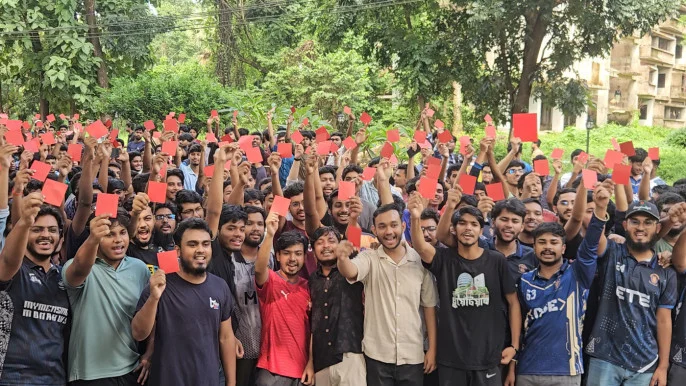
Bdbusinessdaily.com – Students at Chittagong University of Engineering and Technology (CUET) intensified their protest on 26 September by displaying red cards against the institution’s newly appointed vice-chancellor and declaring a boycott.
The demonstration centred on demands for the return of Professor Dr Abu Sadat Mohammad Sayem, who was removed as CUET vice-chancellor on 21 September. Students said they would continue their campaign until he is reinstated and made clear that they do not accept the appointment of his successor.
Red-card protest on campus
Participants gathered on the university campus at about 2pm, holding red cards and chanting slogans opposing the new appointment. The symbolic gesture was used to signal their rejection of Professor Sheikh Shariful Alam, a professor at Khulna University of Engineering and Technology (KUET), who was named as the new CUET vice-chancellor.
The protesters argued that Sayem should remain in office and described his removal as unacceptable. Their programme formed part of several days of demonstrations that began immediately after the government notification was issued.
Sakibur Rahman, a fourth-year student in CUET’s Civil Engineering Department, said the students believed a suitable academic had been removed from his role without justification.
A qualified person has been removed from his position. As Cuet students, we can never accept this. Whatever the reason, we want to see him as our vice-chancellor. That is why we are showing a red card to the new VC in protest.
The students involved in the movement said their activities would not end with the red-card programme. They have pledged to keep organising demonstrations until their demand for Sayem’s reinstatement is fulfilled.
Appointment followed by immediate protests
A gazette notification dated 21 September removed Professor Dr Abu Sadat Mohammad Sayem from the CUET vice-chancellor post and appointed Professor Sheikh Shariful Alam in his place. Alam is a faculty member of KUET.
No explanation for Sayem’s removal was included in the notification. That absence of a stated reason became a central concern for students, who began their protest efforts on the night the change was announced.
Since then, the campus movement has taken several forms. Students have arranged processions and sit-ins, built human chains and launched a mass-signature campaign. The campaign reflects an effort to show that the objection is shared across a wider section of the student body rather than being limited to a single protest event.
On 23 September, students suspended classes and examinations while continuing the signature campaign. The decision brought their opposition into the university’s regular academic routine, underscoring how seriously participants viewed the leadership change.
A boycott or suspension of academic activity can affect students, teachers and university administration alike. For students, it places pressure on the institution by interrupting normal classes and examination schedules. For the university, it creates an urgent need to manage campus operations while responding to concerns about academic leadership and institutional stability.
Teachers also join call for reinstatement
The protest movement has also received support from the CUET Teachers’ Association. On 24 September, the association announced a complete strike demanding that Sayem be returned to the vice-chancellor position.
The strike did not cover residential-hall matters or emergency services. By excluding those functions, teachers sought to maintain essential support for students and the campus community while continuing their broader action over the vice-chancellor’s removal.
The involvement of both students and teachers has given the dispute a wider campus dimension. Students have focused on visible demonstrations and academic boycotts, while the teachers’ association has used a strike to express its position. Both groups are calling for Sayem’s reinstatement.
An unresolved campus dispute
The red-card event on 26 September was therefore another stage in an ongoing campaign rather than an isolated demonstration. The central issue remains unchanged: students and teachers want Professor Dr Abu Sadat Mohammad Sayem restored as vice-chancellor, while rejecting the appointment of Professor Sheikh Shariful Alam.
For CUET’s students, the issue is tied directly to confidence in the university’s leadership. Their slogans, human chains, signatures and boycott announcement all convey the same demand for the previous vice-chancellor’s return.
With classes and examinations already suspended during the protest period and teachers announcing their own strike, the dispute has moved beyond a single appointment notice. Its effect is being felt in teaching, assessment and daily campus activity, although residential halls and emergency services have remained outside the teachers’ strike.
The students have indicated that their movement will continue unless their demands are met. As the protests persist, attention remains focused on whether the call to reinstate Sayem will receive a response and how CUET’s academic activities will proceed while the leadership dispute remains unresolved.
Related Reading
Frequently Asked Questions
What is Cuet students show red card to new?
Cuet students show red card to new is the main topic of this guide. The article explains the context, practical details, and next steps readers should understand.
Why does Cuet students show red card to new matter?
Cuet students show red card to new matters because readers are looking for a useful answer, not just a short summary. Good content should match search intent and help them decide what to do next.