Rethinking Bangladesh’s Growth Story and the Future of Work
Bdbusinessdaily.com – Rethinking Bangladesh’s growth story means looking beyond headline economic progress to ask whether growth is creating enough productive, secure and inclusive jobs. Over the past three decades, Bangladesh has achieved sustained expansion, reduced poverty and improved major social indicators. Yet skills shortages, widespread informal employment, underemployment and child labour continue to constrain the labour market.
The next development challenge is to connect economic gains with decent work. Bangladesh still has an important demographic opportunity, but it will only deliver lasting benefits if workers can gain relevant skills, enter productive employment and adapt to technological change.
Progress in growth, poverty reduction and human development
Since the early 1990s, Bangladesh’s economy has grown at an average annual rate of about 5.6%. Extreme poverty fell from 12.2% in 2010 to 5.6% in 2022, while moderate poverty declined from 37.1% to 18.7% during the same period.
Social progress has also been notable. Life expectancy increased from 62.05 years to 74.27 years, and infant mortality dropped from 59.8 deaths per 1,000 live births to 24.4. Primary completion reached nearly 97%, while lower-secondary completion stood at 76.53%.
These achievements have created a stronger foundation for development. However, better education, improved health and higher incomes do not automatically lead to stable employment or higher productivity. The gap between social gains and labour-market outcomes is now a central issue in rethinking Bangladesh’s growth story.
Making the Most of the Demographic Window
Bangladesh had a population of 171.7 million in 2023, including 120.62 million people of working age. By 2030, almost 70% of the population is expected to be of working age. After that, the dependency ratio is projected to rise, narrowing the window for fully benefiting from the demographic dividend.
A large working-age population is an advantage only when people can participate in the economy and find worthwhile work. In 2023, nearly 39% of working-age people were outside the labour force. Women’s labour-force participation was 41.55%, far below the 80.67% recorded for men, showing how much potential remains underused.
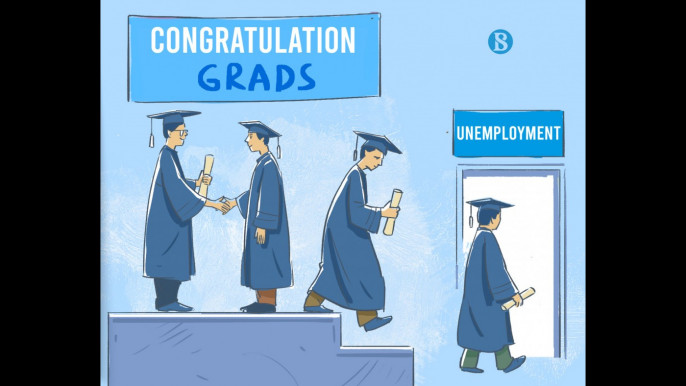
Youth face another difficult transition. Youth unemployment averaged around 8% over the past decade, while 18.9% of young people were not in education, employment or training. Rural youth unemployment was more than double the urban rate, and male youth unemployment was more than twice the female rate.
Bangladesh’s demographic dividend will depend less on the size of its workforce than on the quality of jobs, skills and opportunities available to that workforce.
Why Formal Job Creation Has Lagged
Economic transformation has reduced agriculture’s share of gross domestic product from 30.5% in 1990 to 11.2% in 2024. However, agriculture still employed 44.42% of workers, and more than 70% of the population depended on it directly or indirectly. This shows that the movement away from agriculture has not yet created enough formal, high-productivity employment in industry and services.
Bangladesh must therefore strengthen both labour demand and labour supply. Businesses need conditions that encourage investment, productivity and formal hiring, while workers need education and training that match changing workplace needs. Better migration governance, action against child labour and stronger preparation for the Fourth Industrial Revolution are also essential.
Rethinking Bangladesh’s growth story requires a focus on the quality of employment as well as the pace of growth. A more inclusive labour market can help the country avoid middle-income stagnation and ensure that economic progress reaches women, young people, rural communities and workers in informal occupations.
Frequently Asked Questions
Why is Bangladesh’s demographic dividend important?
The demographic dividend offers a period when a large share of the population is of working age. Bangladesh can benefit if more people enter productive jobs, gain useful skills and contribute to higher economic output before the dependency ratio rises.
What are the main labour-market challenges in Bangladesh?
Key challenges include informal employment, skills mismatches, youth unemployment, underemployment, low female labour-force participation, child labour and insufficient formal jobs outside agriculture.
How can Bangladesh create better jobs?
Practical priorities include improving skills training, helping young people move from education to employment, supporting women’s participation, expanding productive industry and services, and ensuring that technological change creates opportunities rather than exclusion.