Buriganga Riverbank Remains Littered Despite High Court Cleanup Deadline
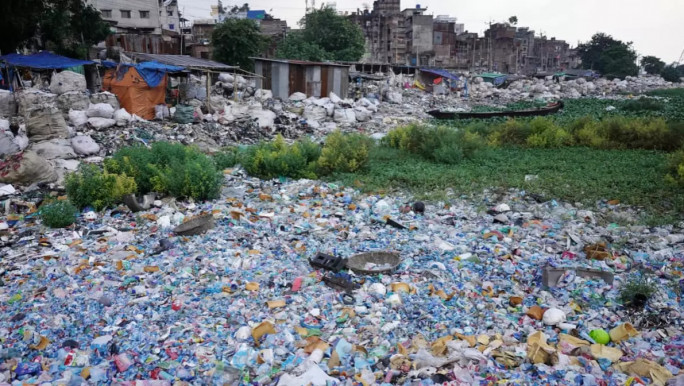
Bdbusinessdaily.com – Large quantities of plastic and other waste were still visible along the Buriganga River in Islampur on Thursday, even though the High Court had ordered authorities to clear the affected riverbank within 15 days.
The order, issued on 2 September, covers the Islampur, Lalbagh and Kamrangirchar areas. Nine days after the directive, a visit to the location found no apparent cleanup operation underway. Polythene bags, discarded bottles, packaging materials and other solid refuse remained spread across several parts of the riverbank.
Some of the waste had also reached the water, where plastic debris could be seen floating on the Buriganga. The continuing presence of rubbish highlights the challenge of enforcing court directions on an already heavily used urban riverbank.
Court names agencies responsible for action
A High Court bench comprising Justice Ahmed Sohel and Justice SM Iftekhar Uddin Mahamud instructed the relevant authorities to remove plastic and all other accumulated waste from the designated stretches of the riverbank within 15 days.
The bench also required a progress report on implementation to be submitted within four weeks. Responsibility for ensuring the removal was assigned to the director general of the Department of Environment, the chairman of the Bangladesh Inland Water Transport Authority, the Dhaka deputy commissioner, and the officers-in-charge of Lalbagh and Kamrangirchar police stations.
The direction places several public bodies and local law-enforcement authorities within the same implementation chain. Clearing visible garbage is only one part of that responsibility; preventing further dumping during and after the cleanup is equally important if the riverbank is to remain free of waste.
However, conditions observed in Islampur suggested that the order had not yet produced a visible change on the ground. Mounds of refuse remained along the bank, with no clear sign of organised removal activity at the time of the visit.
Residents point to continuing disposal of factory waste
People living in the area said the pollution problem is continuing because waste and wastewater from several plastic factories are being discharged onto the riverbank. Their concerns underline that a one-time collection drive may not be enough if new waste continues to arrive from nearby sources.
An Islampur resident, who asked not to be identified, said the scene had remained largely unchanged despite the court’s intervention.
“There has been no significant change here despite the court order. Plastic waste is still lying around as before, and waste is being dumped on the riverbank from different places.”
The account reflects a wider concern for communities beside the river: waste left on the bank can be carried into the water, particularly when it is exposed to rain, wind or changing river conditions. Once plastic enters the river, it becomes more difficult to collect and can spread beyond the original dumping point.
Plastic bottles, packets and polythene are especially conspicuous because they remain visible for long periods and can accumulate in corners of the riverbank. Their presence alongside other solid waste also affects the usability and appearance of public riverfront areas.
Deadline puts focus on implementation
The High Court’s 15-day timeframe gives the named authorities a limited period to demonstrate that the riverbank can be cleared. The separate requirement for a progress report means the implementation process is expected to be documented rather than left as a general commitment.
For residents of Islampur, Lalbagh and Kamrangirchar, the practical test will be whether waste is removed from the bank and whether fresh dumping is stopped. Visible piles of garbage remaining nine days after the order indicate that substantial work would still be needed before the deadline expires.
The involvement of the Department of Environment is significant because the complaint is not limited to scattered household rubbish. Allegations of factory waste and wastewater being released near the riverbank raise concerns about the sources of contamination as well as the accumulated material that must be removed.
The Bangladesh Inland Water Transport Authority and the Dhaka district administration also have roles in the response, while the local police stations were directed to help ensure compliance. Effective coordination among these bodies will be central to meeting the court’s instruction.
Riverbank cleanliness is not simply an aesthetic issue. Waste deposited beside a river can move into the waterway, obstruct local spaces and create a persistent burden for nearby residents. The court order has made the cleanup obligation clear; the remaining question is whether the agencies assigned to carry it out can turn that directive into visible results within the specified period.
As the deadline approaches, attention will remain on the Islampur stretch of the Buriganga and the neighbouring Lalbagh and Kamrangirchar areas. A meaningful response would require both removal of the existing plastic and other debris and action to prevent the continued disposal described by local residents.
Related Reading
Frequently Asked Questions
What is No cleanup seen along Buriganga bank?
No cleanup seen along Buriganga bank is the main topic of this guide. The article explains the context, practical details, and next steps readers should understand.
Why does No cleanup seen along Buriganga bank matter?
No cleanup seen along Buriganga bank matters because readers are looking for a useful answer, not just a short summary. Good content should match search intent and help them decide what to do next.